

Wisdom In All Things Special Series
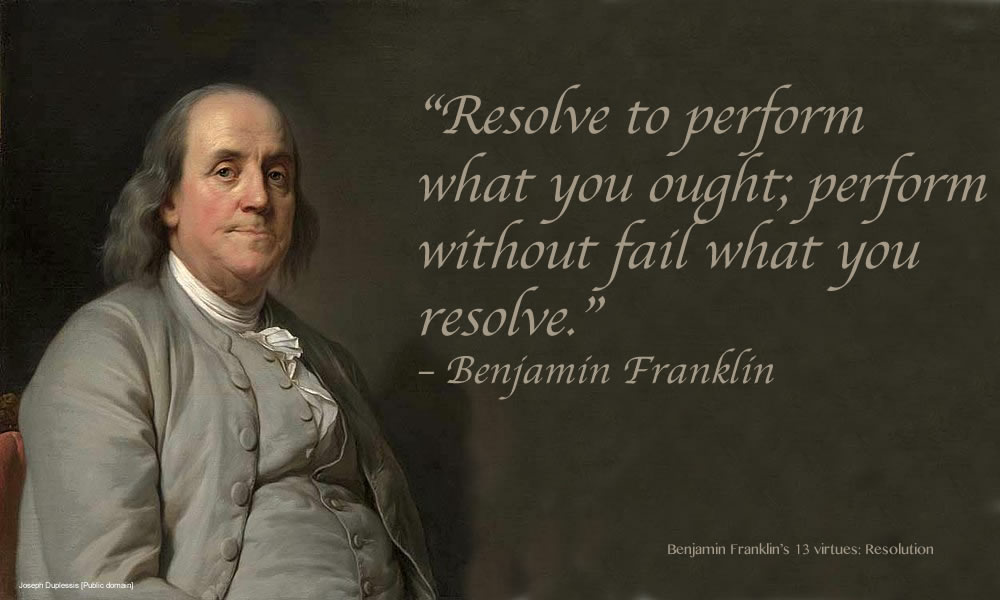
You might say that it was Benjamin Franklin’s disillusionment with a sermon on Philippians 4:8 that was at least partly responsible for his conceiving of “the bold and arduous project of arriving at moral perfection,” that is, his 13 virtues.
A wise life is a virtuous life. There is an expectation of behavior from someone who claims to be wise. This 13-part series will seek to help us understand a life that is exemplified by the characteristics elevated by this great American statesman.
What This Virtue Means
Resolution is the virtue that closes the gap between conviction and action.
Franklin understood that knowing what is right is not the same as doing it. Resolution is the strength of will that carries intention into practice. It is not mere determination in the abstract, but faithfulness to one’s own commitments.
Resolution requires clarity first—knowing what ought to be done—and courage second—doing it despite resistance, inconvenience, or fear. Without resolution, virtues remain ideals admired from a distance rather than disciplines embodied in life.
In this sense, resolution is not intensity or enthusiasm. It is steadfast obedience to what has already been decided.
Why Franklin Practiced It
Franklin was keenly aware of how easily good intentions dissolve.
He observed that people often admire virtue, speak about it eloquently, and even plan for it carefully—yet fail to act when the moment arrives. Resolution was his remedy.
By cultivating resolution, Franklin sought to:
- strengthen reliability of character
- prevent procrastination and self-deception
- ensure that moral insight led to moral action
- build confidence through follow-through
Resolution, for Franklin, was what gave weight to every other virtue. Without it, even the clearest moral vision would remain inert.
Modern Examples of Resolution
Modern life provides endless opportunities to delay action.
Decisions are postponed, commitments softened, and obligations renegotiated internally until resolve evaporates. Resolution pushes back against this drift.
Practicing resolution today might look like:
- following through on difficult conversations you’ve been avoiding
- honoring commitments even when motivation fades
- acting on convictions rather than waiting for ideal conditions
- choosing consistency over comfort
Resolution does not make life easier—but it makes character sturdier.
Want a simple way to practice the virtues the way Franklin did?
Download the free printable virtues chart and weekly habit tracker—modeled after Franklin’s original system.
Only Do What Ought Be Done
I’ll admit it. I’m guilty of romanticizing the past, and this may be one of those times. But when I look back on the period in which Franklin lived, I picture the vast majority of people having a strong sense of “oughtness”. From the way they dressed, spoke, worked, and leisured–there was a way to do things, and that’s they way they did them.
Oughtness: “the quality or state of being morally obligatory”
It may be my age, and probably because I’m a parent, but I am more frequently aware of how things are not being done they way they ought to be done. Anyone from Franklin’s time would no doubt conclude that we have lost our sense of “oughtness.”
To not have the right understanding of what “ought” to be, you, well, end up with what Nike declared in 1978 : Just Do It. What’s it? Anything you want it to be.
Resolve: “decide firmly on a course of action.”
Essentially, Benjamin is saying: get ‘it’ right–with conviction. Acknowledgment, or intellectual assent, is not the same has having a resolve. Like a soldier under command, our conviction should lead to the commitment of carrying out the right course of action.
As I write this, it is Memorial Day. Where we reflect on men and women from generations past, who, with great conviction, carried out what had to be done. That I know I’ve not romanticized.
Resolve to… Resolve
For regular readers, I know I don’t need to spend much time at all discussing what we ought to resolve to do. With this blog, I’ve tried to make clear the fact that God has made clear how we are to live–wisely, in all areas of our lives.
However, I had found a few principles that might be helpful in developing a process for how we can resolve to do what we ought.
Probably most importantly, is understanding that we don’t have to “find” resolve. We develop it.
“Self-discipline isn’t like a reservoir that can be tapped. Instead, it’s like a muscle that can be strengthened with training.” – Jacko Willink, former NAVY SEAL
Up until recently, research led us to believe that resolve, or will-power, was more like a gas tank that we drained and re-filled. However, it is now believed that it is more like a skill that is developed through hard work and training. In other words, the more you practice it, the stronger it becomes.
Martin Meadows, from Highbrow, offers his tips to strengthen resolve. I found them to be more in line with the understanding that resolve is more like a muscle that we need to exercise.
1. “Do It Now.”Resolve will weaken if not applied. When we put off a response to what ‘ought’ to be done, the conviction to follow through begins to wane.
2. “Delay Temptations.” This is where a little “true grit” will be very helpful. If there is any good in procrastinating, this is it. Put off those unhealthy cravings or temptations for a good 15-20 minutes, and they will pass.
3. “Be Honest With Yourself.” Especially when you’ve given into temptation. Quickly question yourself as to the validity of your “reason”. Don’t let yourself get away with anything!
“For instance, if you notice it’s getting cloudy outside and you’re supposed to go for a jog, you may be tempted to think, “It’s going to rain soon, so I’d better stay home so I don’t get sick.” Stop this thought process and be honest with yourself. You’re making an excuse so you can be lazy without feeling guilty about it.”
4. “Think of the Consequences.”On the other side of being critical of what may do you in, are the consequences of your actions (or, in action) if you do. What will it cost you to give in? Let your mind step through what all will result if you decide to take the easy way out. Remember, resolve only grows when practiced.
5. “Imagine Others Can See You.”Or, if you really want to pile on the conviction, just imagine Jesus standing beside you. I sometimes imagine a day in the future when I’ll get to (or have to) talk about this situation I’m contemplating making excuses to try and avoid. Before you take your foot off the gas, picture in your mind a day in the future when you’ll be able to say, “I saw it through.”
These five tips, or principles, reinforce the truth behind possessing resolve: we can all have it, and that it can make a significant difference, but only if we’re serious about making habitual. That is, resolve to… resolve.
How to Practice Resolution This Week
Franklin practiced resolution by narrowing focus.
To begin:
- Identify one thing you know you ought to do
Not something vague or aspirational—something concrete and clear. - Decide precisely when and how you will do it
Remove ambiguity. Resolution weakens when details are undefined. - Perform without renegotiation
When resistance arises, do not reopen the decision. Act. - Reflect at the end of the week
Did follow-through strengthen confidence? Did avoidance previously drain energy?
Resolution grows when decisions are honored rather than debated endlessly.

Download the exact habit-tracking chart Benjamin Franklin used to pursue the 13 virtues.
This free, printable PDF gives you the (modernized) chart Franklin used to track his progress toward moral growth, designed to help you slow down, pay attention, and cultivate better habits one week at a time.