

Wisdom In All Things Special Series
You might say that it was Benjamin Franklin’s disillusionment with a sermon on Philippians 4:8 that was at least partly responsible for his conceiving of “the bold and arduous project of arriving at moral perfection,” that is, his 13 virtues.
A wise life is a virtuous life. There is an expectation of behavior from someone who claims to be wise. This 13-part series will seek to help us understand a life that is exemplified by the characteristics elevated by this great American statesman.
What This Virtue Means
Justice, for Franklin, was not passive fairness—it was active responsibility.
He defined injustice not only as causing harm, but also as failing to do good when duty required it. Justice demands more than restraint; it calls for engagement.
This understanding expands justice beyond legality into morality. A person may avoid wrongdoing and still fall short of justice by neglecting responsibility.
Justice, then, is the virtue that governs how we treat others—both in what we refuse to do and in what we commit ourselves to do.
Why Franklin Practiced It
Franklin believed society depended on mutual responsibility. Injustice weakened trust, cooperation, and community.
He recognized that harm often results not from malice, but from indifference. Justice required attentiveness—to needs, obligations, and consequences.
By practicing justice, Franklin sought to:
- prevent harm through restraint
- fulfill responsibility through action
- maintain fairness in personal and public dealings
- strengthen the moral fabric of community
Justice ensured that virtue extended beyond the self into shared life.
Modern Examples of Justice
Justice today is often discussed in abstract terms, yet practiced inconsistently.
Practicing justice might include:
- treating others fairly even when inconvenient
- honoring obligations rather than avoiding them
- speaking up when silence enables harm
- extending benefits where responsibility exists
Justice requires courage—not merely conviction.
Want a simple way to practice the virtues the way Franklin did?
Download the free printable virtues chart and weekly habit tracker—modeled after Franklin’s original system.
Justice is Our Duty
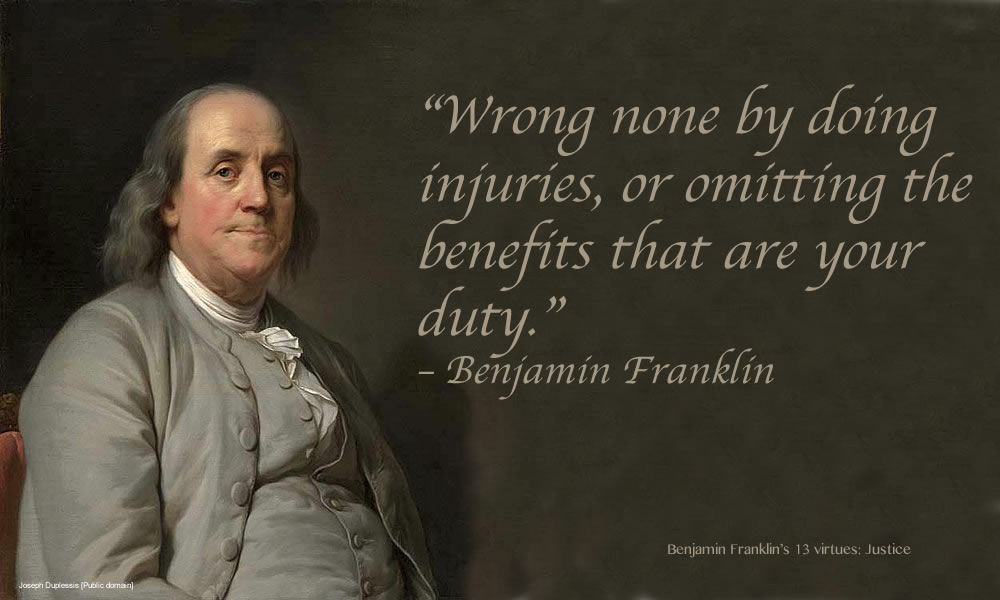
You’ll find in Franklin’s description, the essence of justice. The balance of not causing hurt, unnecessarily, and, being sure not to withhold what is good. And neither is without effort or great responsibility.
His description is not only an explanation of justice but the very means of bringing it about. Do not injure, AND, do not withhold good. That is justice–and is how we do justice.
However, doing right by someone might bring injury–bodily or otherwise. We sometimes can’t avoid it. In order to do right, in may very well be painful to others. And on the other side of that, if we’re avoiding doing the right thing because it might bring pain, we will be guilty of withholding good.
We want to avoid going too far, as well as not going far enough. As it is written: “Do not withhold good from those to whom it is due, when it is in your power to do it.” (Proverbs 3:27)
Franklin’s reference to duty is precisely in line with this proverb. Unfortunately, we don’t hear much of duty these days. I feel that the idea of duty has been absorbed and used as a form of narcissism. That is, we have a duty unto ourselves to ensure that we get justice.
However, Benjamin rightly prescribed justice as being toward others. The responsibility we have to be “morally right and fair” is outward-facing. What he doesn’t state, but I believe he would agree with, is that our duty to others may mean a sacrifice on our part.
Answering Our Call of Duty
Franklin’s description of justice gives us two considerations for reflection. On one hand, we are to care for our actions toward others, and on the other, is our duty to not withhold good.
Unfortunately, I too frequently find myself acting or responding more out of obligation than duty. In one sense, we are obligated to care for others simply by virtue of our having been shown such grace by God. But having, and acting out of, a sense of duty, rightly positions are minds and hearts. It is a calling and a charge that should cause us to willingly and sacrificially rise up for the sake of those who can’t or won’t. Obligation is so short-sighted, and selfish.
You can tell so much about where we’re at as a society by doing a simple Google search. Type in “call of duty” and you’ll only get results for the video game of that same title. In nearly 10 pages of results, there were only two links that were not associated with the game. It took me a while, but I did find what I was looking for. A description that provides an excellent understanding of duty–which was so glaringly absent from that original search, and, implicates so many:
“Duty is set apart from any other way of acting. You might choose to act for spurious reasons, hateful reasons, deleterious reasons or sheer simple meanness but Duty compels you to do what is only moral and right. No fear of punishment, no hope of reward, or any other reason other than the requirement to do the specified Duty. To hear the Call of Duty is to know that something must be done for the most noble reason and no other reason.” – Scott Hundley
Immediately when I hear the word duty, I think of our military. To spur on your sense of duty, I commend to you this speech from General Douglas MacArthur. It was delivered to cadets at West Point in 1962, as a result of his being awarded the Thayer Award for “outstanding character, accomplishments, and stature in the civilian community draw[ing] wholesome comparison to the qualities for which West Point strives, in keeping with its motto: “Duty, Honor, Country.””
“Duty, Honor, Country” — those three hallowed words reverently dictate what you ought to be, what you can be, what you will be. They are your rallying point to build courage when courage seems to fail, to regain faith when there seems to be little cause for faith, to create hope when hope becomes forlorn.” – General Douglas MacArthur
While he is speaking of the military, it certainly has its application to our civilian lives. With our lives, we are to wrong no one by injuring them or omitting any good from them that we have the power to give.
“Wrong none by… doing injuries…”
It goes without saying that our words can, and do, bring great harm to others. That is above and beyond what we may do physically. Ephesians 4:29 directly addresses this, and provides the “duty” our mouths are bound by: “Let no corrupting talk come out of your mouths, but only such as is good for building up, as fits the occasion, that it may give grace to those who hear.”
In your mind, step through the people you know you’ll interact with today. Ask yourself, How might I keep from not just injuring them, but specifically, lifting them up with my words? Decide now how you will speak or act toward them that ensures that they not only don’t feel injured but that they are protected and cared for.
“Wrong none by… omitting the benefits that are your duty.”
Just as we are to control our words, we are to conduct ourselves with respect to how what we do will ensure the benefit of others. A popular reference for this is the Golden Rule. However, considering this now, “do unto others, as you would have them do unto you” rings a little too conditional rather than dutiful.
Without regard for it coming back to you in a positive way, are you more inclined to watch out for your own interests, above the interests of others? How well are you doing at making sure you don’t keep back what is right and good for others? If justice is as Franklin describes, then is it our duty to identify the good that would benefit someone, and ensure its delivery.
Both as a citizen, and especially as a Christ-follower, answering the call of duty echoes the words of General MacArthur to those young cadets on that historic day in 1962: “Duty, Honor, Country… create in your heart the sense of wonder, the unfailing hope of what next, and the joy and inspiration of life. They teach you in this way to be an officer and a gentleman.”
How to Practice Justice This Week
Franklin approached justice through deliberate attention.
To begin:
- Identify one area of responsibility
This might involve family, work, community, or obligation. - Ask two questions
Where might harm be occurring? Where might good be neglected? - Act intentionally
Choose one concrete action that fulfills responsibility or prevents harm. - Reflect at week’s end
Did action feel costly? Did conscience feel clearer?
Justice grows when duty is embraced rather than avoided.
Download the exact habit-tracking chart Benjamin Franklin used to pursue the 13 virtues.
This free, printable PDF gives you the (modernized) chart Franklin used to track his progress toward moral growth, designed to help you slow down, pay attention, and cultivate better habits one week at a time.