

Wisdom In All Things Special Series
You might say that it was Benjamin Franklin’s disillusionment with a sermon on Philippians 4:8 that was at least partly responsible for his conceiving of “the bold and arduous project of arriving at moral perfection,” that is, his 13 virtues.
A wise life is a virtuous life. There is an expectation of behavior from someone who claims to be wise. This 13-part series will seek to help us understand a life that is exemplified by the characteristics elevated by this great American statesman.
What This Virtue Means
Sincerity is the alignment of inner life and outward expression.
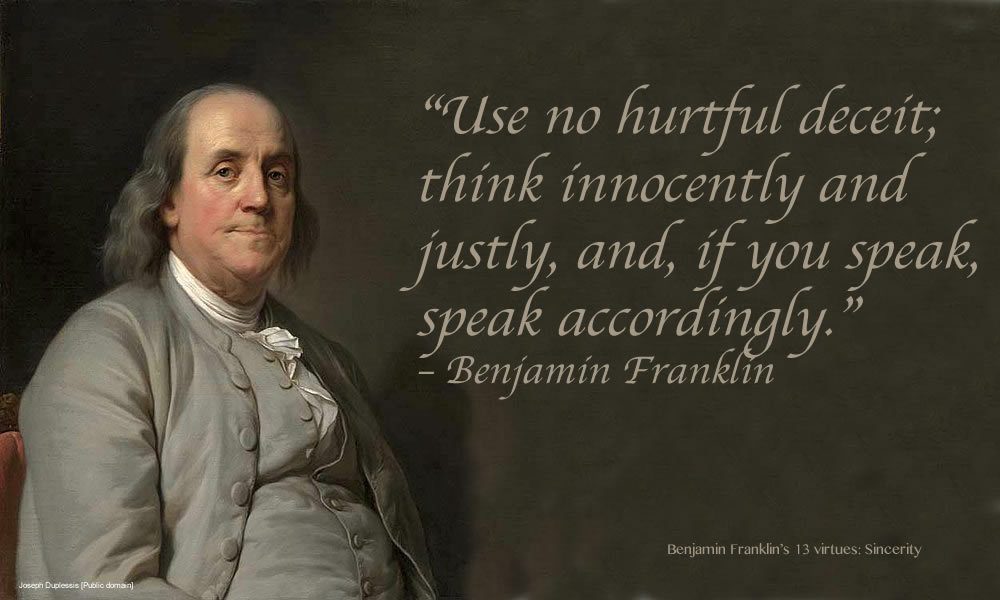
Franklin understood sincerity as more than truth-telling in speech. It begins in thought. To “think innocently and justly” is to resist distortion—of facts, motives, or intentions—before words are ever spoken.
Deceit, in Franklin’s view, was not limited to overt lies. It included exaggeration, omission, flattery, manipulation, and any form of speech that presented reality in a way that served self-interest at the expense of truth.
Sincerity, then, is not bluntness or harsh honesty. It is integrity of mind and mouth—thinking clearly, judging fairly, and speaking in a way that faithfully reflects both.
Why Franklin Practiced It
Franklin lived in public life. He negotiated, persuaded, published, and led. He understood that credibility is fragile and easily lost.
He observed that deceit—even subtle forms—erodes trust over time. While it may secure short-term advantage, it weakens relationships and undermines influence.
By practicing sincerity, Franklin sought to:
- preserve trust and credibility
- avoid the inner division caused by duplicity
- align his public words with private convictions
- strengthen the moral authority of his voice
Sincerity, for Franklin, was not merely ethical—it was practical. Trust was the soil in which cooperation and leadership grew.
Modern Examples of Sincerity
Modern life rewards impression management. Words are often shaped less by truth than by image, strategy, or approval.
Practicing sincerity today might look like:
- resisting exaggeration to appear more competent or interesting
- avoiding selective honesty that hides inconvenient truths
- speaking plainly rather than strategically
- letting actions confirm words
Sincerity creates coherence. It removes the burden of maintaining appearances and replaces it with quiet confidence.
Want a simple way to practice the virtues the way Franklin did?
Download the free printable virtues chart and weekly habit tracker—modeled after Franklin’s original system.
We Act as We Think
“For as he thinks within himself, so he is.” (Pr. 23:7a) Actions follow the mind. That is, we tend to do as we think.
While sincerity is our “being free from pretense, deceit, or hypocrisy”, it can’t happen at the moment. It is somewhat premeditated as Benjamin implies. Decide not to be hurtful, and therefore think innocently–until evidence suggests we do otherwise.
He does add that we are also to think justly. While we seek to do no harm, our thinking should lead to our understanding of right and wrong about the person, the topic, or the situation.
Be genuine, honest, and truthful in your thinking, and speak accordingly.
If we speak.
We do have the option of not speaking. Fewer words are normally more prudent. And, our being “slow to speak” (James 1:19), gives speaking and acting with sincerity its truest aim.
Franklin’s first four words really describe a principle. The foundation on which we should first, govern what we think, and then, guide what may follow from those thoughts.
Sincerity As the Bedrock
It was said that Franklin’s virtues of Sincerity (and Justice), provided him opportunities reserved for the honorable and that he owed to it (sincerity and justice) the collective effect of all the virtues. You could say that it was the means by which he was able to have an influence, where he would otherwise not:
“…the joint influence of the whole mass of the virtues, even in the imperfect state he was able to acquire them, all that evenness of temper, and that cheerfulness in conversation, which makes his company still sought for, and agreeable even to his younger acquaintance.” (emphasis mine)
Sincerity was the bedrock that gave who he was the span of influence that was even sought after. It opened doors. And left its mark.
How sincerity penetrates:
- It puts people at ease; they are more receptive to what you’re saying, and hopefully, because you’re telling the truth, they hear what they need to hear.
- People will trust you. Because you are trusted, you will be sought out.
- People are drawn to you. Because you are sincere, you care, and are fair. That is very appealing–to everyone.
- People know they will get the truth. Because you are sincere and trustworthy, people can expect to get the “truth in love.” It is what Kim Scott refers to in her book, Radical Candor, as being the right combination of “caring personally, and challenging directly.”
- It heals. Just as a genuine apology–sorrow with sincerity–is received, so sincerity mends the relationship and is restorative, accelerating the change or correction intended by sharing the truth.
There are strong similarities between sincerity and love. When you consider the description of love from 1 Cor. 13, we see the correlation to Benjamin’s application of sincerity. Love is… kind, does not envy, boast or is proud… and rejoices in the truth. It guards against the truth not bearing its fruit. It’s how the truth gets through, and has its way.
When love plays out, it uses the right words so as to not harm, which flows from a mindset that thinks the better of the other person or group, with the intention of seeing through to what is just.
How can we improve if not for being presented with the truth? And how would we entertain the truth if not for someone establishing the needed trust by being sincere?
How to Practice Sincerity This Week
Franklin practiced sincerity by cultivating awareness.
To begin:
- Observe your speech carefully
Notice where words are softened, sharpened, or shaped to gain advantage. - Examine motives beneath expression
Ask whether truth is being adjusted to protect image or comfort. - Practice alignment
Let your words reflect what you truly think and believe—without cruelty or pretense. - Reflect at week’s end
Did sincerity simplify relationships? Did honesty bring clarity or cost?
Sincerity grows when truth is valued more than convenience.

Download the exact habit-tracking chart Benjamin Franklin used to pursue the 13 virtues.
This free, printable PDF gives you the (modernized) chart Franklin used to track his progress toward moral growth, designed to help you slow down, pay attention, and cultivate better habits one week at a time.