

Wisdom In All Things Special Series
You might say that it was Benjamin Franklin’s disillusionment with a sermon on Philippians 4:8 that was at least partly responsible for his conceiving of “the bold and arduous project of arriving at moral perfection” that is his 13 virtues.
A wise life is a virtuous life. There is an expectation of behavior from someone who claims to be wise. This 13-part series will seek to help us understand a life that is exemplified by the characteristics elevated by this great American statesman.
What This Virtue Means
Tranquility is steadiness of spirit.
Franklin recognized that many disturbances do not originate in events themselves, but in our response to them. Tranquility resists surrendering peace to circumstances beyond control.
This virtue does not deny difficulty or minimize pain. Instead, it distinguishes between what deserves concern and what does not—between what can be changed and what must be accepted.
Tranquility preserves judgment by preventing minor disruptions from dominating attention.
Why Franklin Practiced It
Franklin observed that agitation wasted energy and distorted perspective.
By allowing trifles to disturb him, he risked sacrificing peace over matters that ultimately held little consequence. Tranquility restored proportion.
By practicing tranquility, Franklin sought to:
- preserve clarity under pressure
- reduce emotional exhaustion
- maintain perspective amid disruption
- cultivate peace independent of circumstance
Tranquility protected wisdom from being eroded by constant reaction.
Modern Examples of Tranquility
Modern life multiplies disturbances.
Practicing tranquility today might look like:
- releasing irritation over delays or inconveniences
- accepting setbacks without spiraling
- choosing calm where anxiety is habitual
- refusing to internalize every disruption
Tranquility reclaims peace that reaction freely surrenders.
Want a simple way to practice the virtues the way Franklin did?
Download the free printable virtues chart and weekly habit tracker—modeled after Franklin’s original system.
Tranquility or Perpetual Perturbation
Keep Calm and Carry On.
Those words made up a poster created by the British government in 1939. They were meant to inspire courage in English citizens preparing for the onslaught of World War II.
Surprisingly, they were not used extensively. It wasn’t until 2000 that they were rediscovered in a bookstore in Northern England. Since that time, they have taken on a life of their own and hardly reflect the history and conviction for which they were conceived.
While World War II was no trifling matter, the admonishment given to those facing that overwhelming situation is really good advice for any circumstance, especially those of little or no consequence.
Keep Calm and Carry on.
We shouldn’t get too shook by a trifle. Something that is “of little value or importance” should not be worried about, or be allowed to interfere or distract.
A friend and I had spent a week working at a camp in Bemidji, MN. If you’ve ever been to Minnesota in the summer, you are probably well acquainted with our state bird: the mosquito.
One early evening, we wanted to have some fun after a day’s work and decided to go golfing. I only lasted two holes. The air was so thick with gnats and mosquitoes, I simply could not bear the psychological warfare.
Sure, they’re pretty harmless, unless you let them get to you. First, they break you mentally. And not too long after that, they have you convulsing and flailing your arms in the air like one of those inflatable tube people.
However, my friend was able to ignore them. Crawling in his nose, ears, and eyes, he had the remarkable ability to just play on. Evidently, he was blessed with the superpower of being imperturbable.
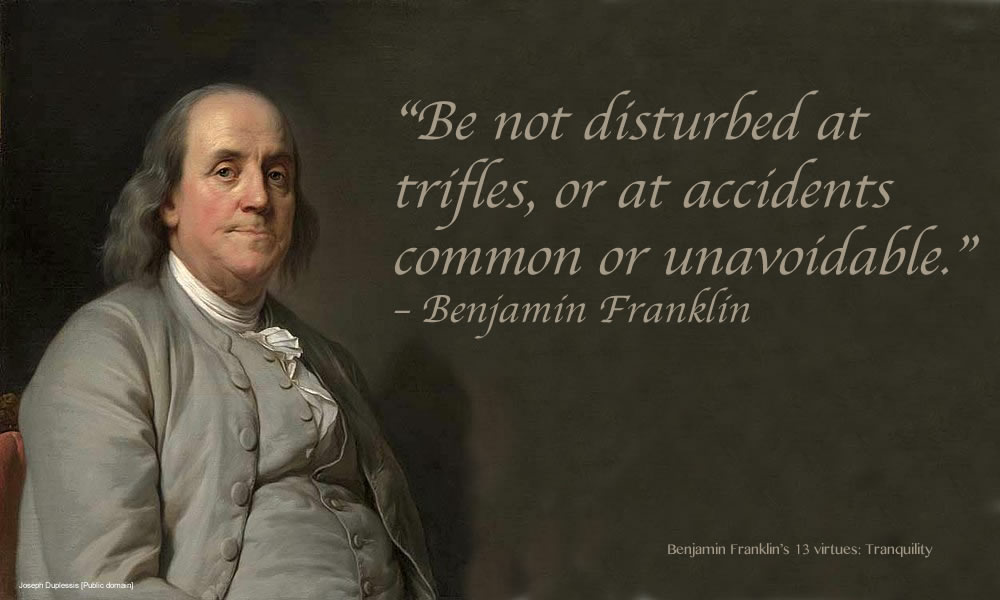
Franklin’s admonition is to “keep calm and carry on”. We can’t allow trifles and those events and circumstances that are common and unavoidable to trip us up or pull us away from what is actually important. The inability to find tranquility can develop into a perpetual state of being perturbed.
Being Undisturbed by Trifles
There are a number of questions or areas to investigate as we deal with the ways the trifling matters of life get to us. From understanding what you’re feeling and considering others’ perspectives, to overthinking things and beating yourself up. However, I want to focus on two areas specifically.
The first is to try and quickly dispel our lunacy. I know that for me, things become much larger than they actually are, and far more dangerous in my mind when I detach from reality. The little things get to me and reality is distorted.
The second is a caution about dealing with anger. Whether you have a quick fuse or your anger is always on simmer, handling the “little things” can spare you and others unnecessary harm.
Less like Kirk. More like Spock.
Reality is pretty important. Spock is always good about pointing to those instances of reality we mere humans like to skip past.
“Insufficient facts always invite danger.” – Spock
Captain Kirk, on the other hand, is, well, the opposite. Reality doesn’t seem to stop him from going where his heart leads him. It’s pretty easy to see who would be the “arm flailer” and who would just simply move to an area that had no gnats.
Here’s how we can apply more reality to trifles, and keep from overreacting emotionally and letting them drive us nuts.
- Identify what is true in the situation. What is true of you, God, and elements of the (trifling) situation?
- Is this one of life’s trifles? Can I change it or avoid it
- What will happen if I explode? That is, what will be the outcome if I don’t deal with reality, and begin flailing my arms?
You can only manage what is in your control. Set aside the rest.
“When you eliminate the impossible, whatever remains, however improbable, must be the truth.” – Spock
Let logic “take the wheel”. When you skip past some logical considerations, you become a little too much like Caption Kirk, and not enough like Spock.
Less like Hulk. More like Banner.
Seeing the Hulk puts the need for anger management into perspective. Though we don’t turn green, and burst out of our clothing, when we erupt it can be deadly if not at least extremely painful. People run in fear for their lives and property damage is exponential.
Steve Rogers: Doctor Banner, now might be a good time for you to get angry.
Bruce Banner: That’s my secret, Cap: I’m always angry.
From The Avengers
If you’ve reached that point, or can quickly get there, hopefully, you can learn to “walk it back” to where you “left logic behind.” Additionally, here are a few steps to take to manage the “inner monster” with help from The Comic Vault:
- Recognize your monster. And what triggers it. Why are you angry? What “takes you there”? Can it be diffused, or can you distance yourself from it?
- Talk to the monster, and make it your ally. The monster can be put to good use when it is controlled and directed.
- Identify the “something positive” you can channel that anger toward. When feeling like you need an outlet, determine how you can direct that emotion in a way that something good will result from expressing it.
We cannot avoid the unavoidable. But we can avoid what is. Remember: more like Spock and Banner, less like Kirk and The Hulk.
Being calm, cool, and collected means you will avoid the tendency to be perpetually perturbed.
Keep Calm and Carry On.
How to Practice Tranquility This Week
Franklin practiced tranquility through acceptance.
To begin:
- Identify frequent disturbances
Notice patterns of irritation or anxiety. - Ask what is truly unavoidable
Separate what can be changed from what must be endured. - Practice release
Consciously let go of one recurring frustration. - Reflect at week’s end
Did acceptance preserve peace? Did resistance increase unrest?
Tranquility grows when perspective replaces reaction.

Download the exact habit-tracking chart Benjamin Franklin used to pursue the 13 virtues.
This free, printable PDF gives you the (modernized) chart Franklin used to track his progress toward moral growth, designed to help you slow down, pay attention, and cultivate better habits one week at a time.